
The Three Drivers of Eating: Why Hunger Returns After Surgery
One thing many patients notice soon after metabolic and bariatric surgery is how much quieter food noise becomes. The constant thinking about food, the pull towards the pantry, the "what's next" - it eases off, and food stops taking up so much space.
Then, somewhere down the track, it starts coming back. A bit of grazing in the afternoons. Hunger that turns up faster than you expected. That familiar mental chatter about food. And underneath it, a quiet worry that maybe something has gone wrong - that the surgery has stopped working, or that you are slipping back to square one.
If this resonates, it’s important to understand that what you’re experiencing is not a personal failure. Read on to understand more about why hunger returns after bariatric surgery.
The return of hunger is normal
The return of hunger, food noise and grazing after bariatric surgery is something many people experience. Research indicates that beyond the first year or so, appetite, cravings and interest in food commonly increase again for many patients. This is associated with gradual shifts in appetite-regulating hormones which can also be impacted by the way in which you're eating.
The return of hunger is a normal and expected part of the bariatric journey, not a personal failure or a sign that your surgery has "stopped working."
Part of the challenge is not the hunger itself but the assumption that comes with it - that you should be able to push through on discipline alone, and that wanting to eat for reasons beyond physical hunger is a weakness. In reality, neither of these are true, and understanding why you’re experiencing hunger in the first place is a powerful first step in being able to manage this more effectively.
Eating is driven by more than just physical hunger
The factors which drive us towards food can be broadly categorised as: physical, habitual or emotional. While eating can sometimes be driven by a single, isolated cause - for example, a physical need for food - a lot of the time, these broader factors may overlap, meaning that hunger could be driven by any combination of physical, habitual and/or emotional factors.
This is part of why willpower alone is not particularly helpful. Different food urges have different drivers, so they call for different responses, not just more effort.
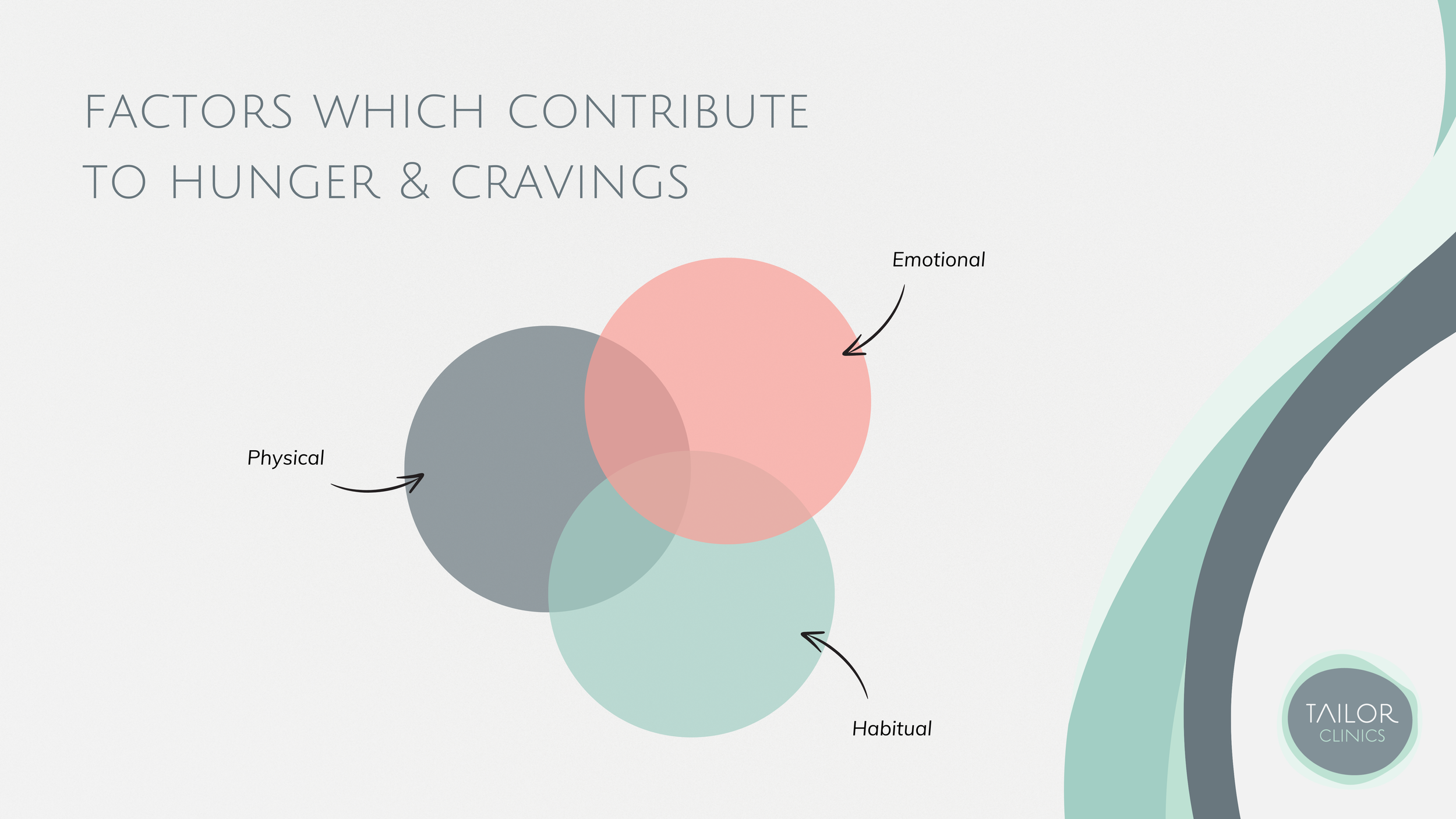
The three drivers, in simple terms
Physical
This is your body's genuine request for energy and nutrients. It is normal, healthy and expected - your body doing its job. After surgery, physical hunger can feel different to how it once did. It may come on faster, feel less familiar, and it may change over time. Just like other physical signals like low energy or tired muscles, this is simply feedback from your body.
Emotional
This is eating to soothe, shift or manage a feeling - stress, sadness, boredom, loneliness, even celebration. Emotional eating tends to arrive suddenly, feel urgent, and attach itself to specific foods rather than food in general. It is a very common experience, and it is not a character flaw. It is simply a coping strategy that most of us learned when we were young.
Habitual
This is eating driven by routine, environment and cues rather than physical need. Walking past the kitchen and looking inside the fridge. The biscuit that comes with the cup of tea. Eating because it is a certain time, or because "it is what we always do here." Habits are efficient - your brain builds them so you do not have to decide everything from scratch. That efficiency is helpful in many areas of our life, but can also result in what's often referred to as “mindless eating.”
First step: awareness comes before action
The first step in changing your eating habits is to become very aware of your current ones.
Most people dive straight in with a structured eating plan, more restriction and more willpower. While this may be motivating to start with, it’s rarely sustainable long term. So before you create the “forbidden foods list” - a more helpful starting point might be to simply get curious about what’s currently driving your hunger and cravings. When you experience an urge to eat, practice asking: “what’s driving this right now?” Is this physical? Emotional? Habitual? Or perhaps a combination?
That question creates a small gap between the urge and the response - a moment of choice, where before there may just have been an automatic reaction. It allows space for you to notice what is actually happening. While this can be a little uncomfortable or confronting at times, these insights are really helpful for better understanding how to change your relationship with food.
Tired of fighting hunger, cravings and food noise?
The Bari-IQ Method is an online course created and presented by Professional Coach, Lorraine Hamilton, and Registered Nutritionist, Nicole Freebairn, designed for bariatric patients who are at least one year post-op and have experienced the return of hunger.
The Bari-IQ Method gives you a practical framework for responding to hunger, cravings and food noise - so food can take up less of your time, energy and headspace, leaving more room for the things that matter to you.
Disclaimer: This article is educational and for general awareness. It is not personalised clinical advice. If you have concerns about your eating, weight or health after surgery, please speak with your bariatric team or a registered health professional.